


Ryan Mandell
Vice President, Strategy & Market Intelligence
The collision industry is at a turning point. Advances in vehicle technology, rising repair costs and ongoing supply chain disruptions are putting even more pressure on organizations to improve outcomes by controlling severity and reducing cycle time. In this environment, accuracy and efficiency are equally as important in driving operational success.
Highlighted in Mitchell’s data are emerging trends that reveal just how auto insurers and collision repairers can adapt their workflows, sourcing strategies and estimating processes to better navigate this growing complexity without sacrificing consistency, quality or customer satisfaction.
Smarter Vehicles, Costlier Repairs
Vehicle technology continues to evolve at a rapid pace. Sensors, cameras, radar systems and advanced materials have transformed what used to be straightforward automobile repairs into multidisciplinary technical work. A minor impact can now trigger a chain of required operations, including diagnostic scans, module programming, airbag inspections and Advanced Driver Assistance System (ADAS) recalibrations.
Over the past decade, ADAS calibrations have become one of the fastest-growing contributors to repair complexity and severity. Mitchell data shows that the percentage of estimates with a calibration line grew by 31.4% year-over-year in 2025 with an average cost per estimate of $688 when present. The number of calibrations per repair also grew last year by nearly 10% compared to 2024.
ADAS components are sensitive to alignment, mounting and even minor body dimension changes. Failure to identify and complete required calibrations can compromise system performance and create financial and liability exposure for insurers and repairers.
At the same time, the growing prevalence of calibrations has introduced new operational opportunities. Collision centers that invest in technology to more easily identify manufacturer-recommended calibrations and perform them in-house may be better positioned to reduce repair delays, improve scheduling control and generate additional revenue while maintaining tighter repair quality oversight.
Supply Chain Shifts Affecting Parts
In addition to increasing vehicle complexity, global trade tensions and shifting tariff regimes have introduced a new layer of uncertainty when it comes to parts procurement. Part prices began to increase last summer and continue to rise as manufacturers look for ways to claw back tariff losses. In 2025, OEM prices jumped 4.21% compared to 3.52% in 2024. Similarly, aftermarket parts experienced inflation at a rate of 3.89%, an increase from 3.08% in 2024.
While the U.S. Supreme Court nullified tariffs levied under the International Emergency Economic Powers Act (IEEPA), the tariffs on the auto industry remain in place, including whole vehicles, parts and several key components and raw materials that were imposed under Section 232 of the Trade Expansion Act of 1962. As a result, it is likely that costs will continue rising for the foreseeable future, especially when coupled with the threat of growing manufacturing expenses from higher oil prices.
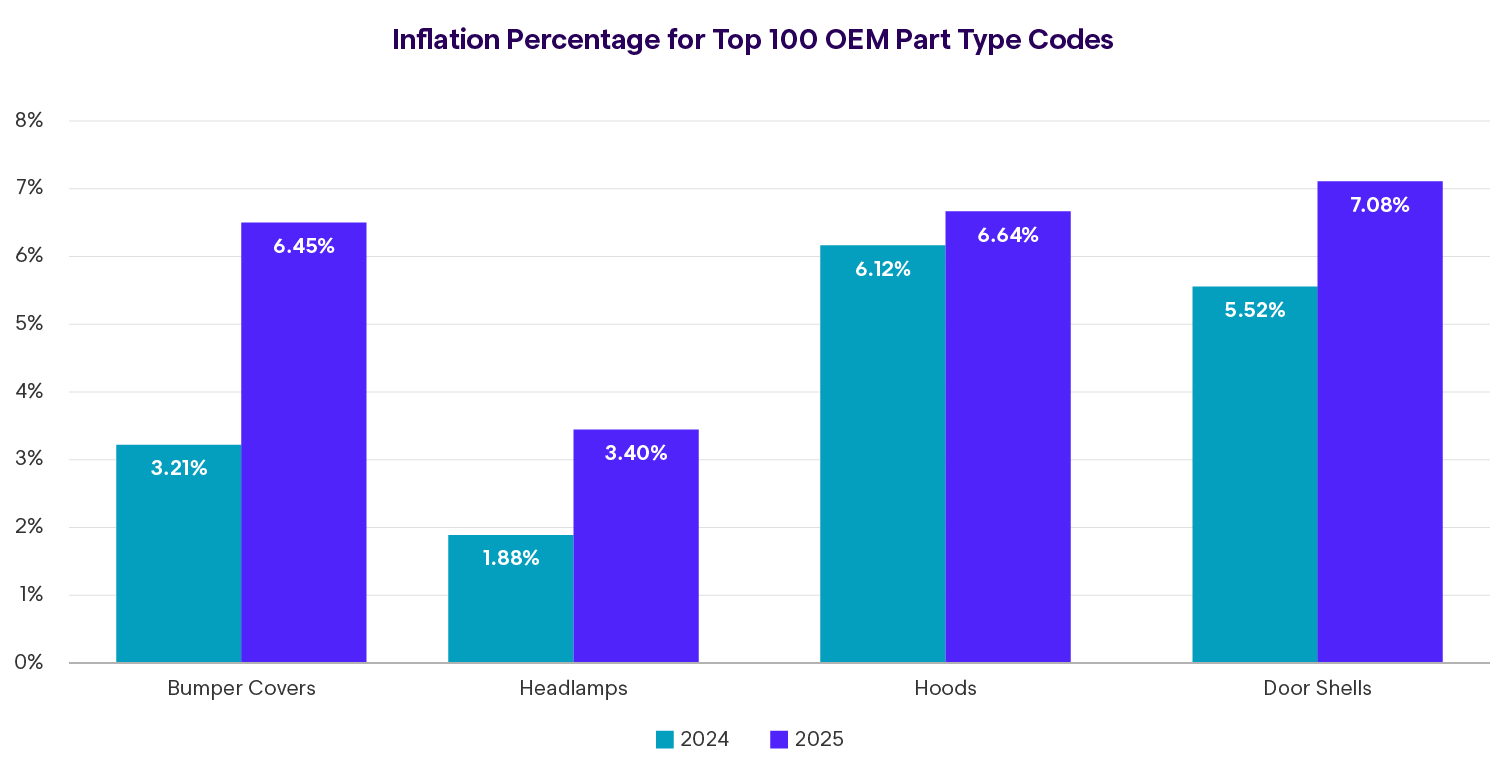
Inflation is not occurring uniformly, however. Plastic components such as bumper covers and headlamps have experienced more significant pricing increases than sheet metal parts including hoods and doors. This reflects greater OEM reliance on globally sourced materials used in plastic parts manufacturing. The trend is especially important as plastics continue to make up a larger portion of an automobile’s composition (projected compound annual growth rate of 4.6% through 2030). As vehicle construction evolves, insurers and repairers will face ongoing pricing pressure for both parts and whole vehicles, necessitating a more agile and diversified parts procurement strategy.
Repair vs. Replace: A Strategic Opportunity
Although supply chains have shown their resilience over the past 18 months, vehicle manufacturers shifting the geographic footprint of their supplier base is adding complexity and may also create gaps that impact parts availability. To prepare, collision centers and carriers should develop strategic relationships with suppliers — including OEMs, aftermarket companies, recyclers and remanufacturers — as well as maintain flexible sourcing strategies that enable real-time comparisons across supplier options when parts replacement is necessary.
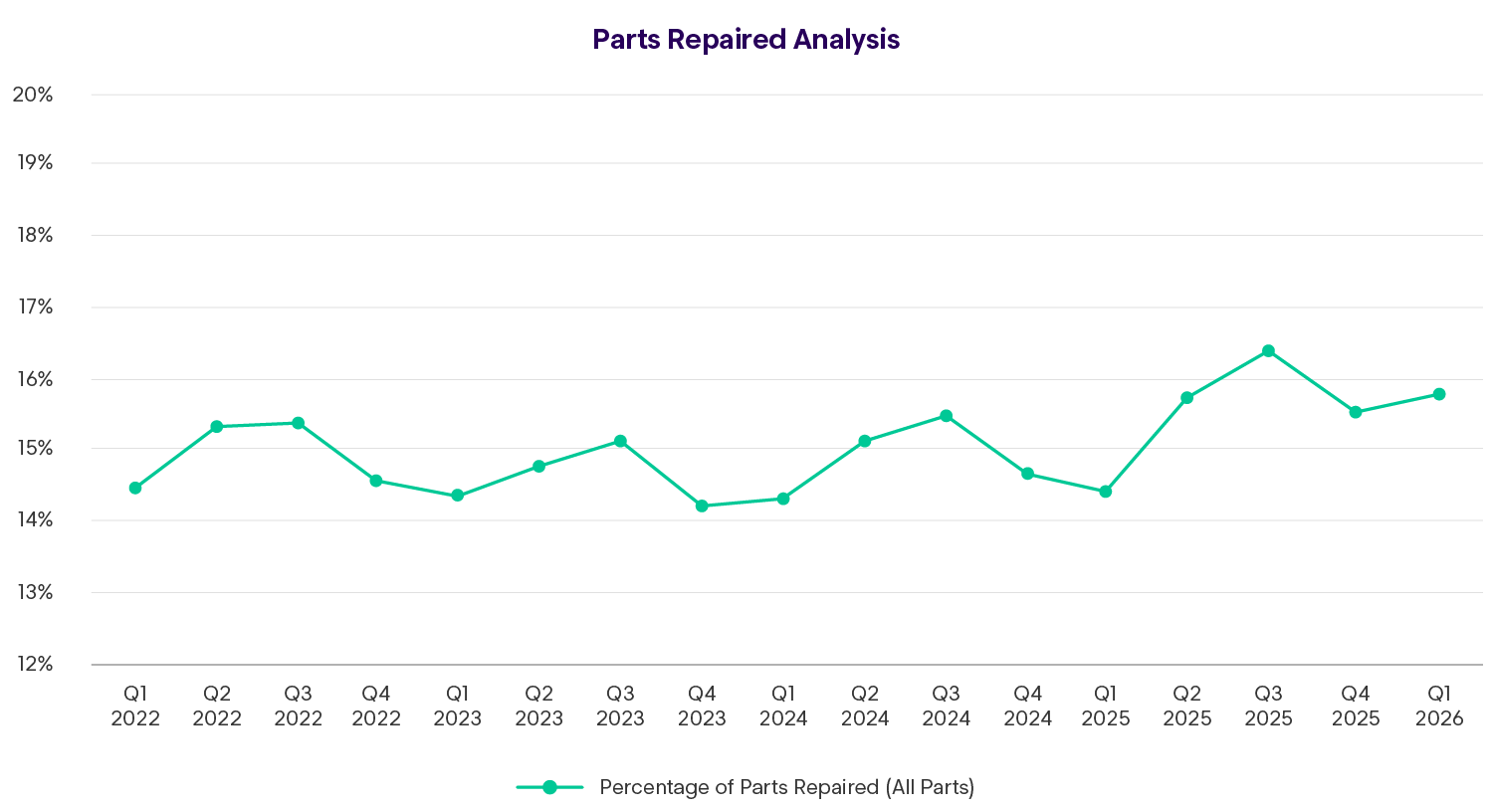
In addition, a stronger emphasis on repairing instead of replacing parts can reduce the dependence on volatile supply chains while shortening cycle time by keeping work within a repair facility instead of requiring external fulfillment. Mitchell data demonstrates this, showing that keys-to-keys cycle times for drivable repairs under $5,000 in total severity were completed eight tenths of a day quicker when the estimate included at least one “repair” line.
Beginning in 2025, the percentage of parts repaired began to increase for the first time in more than a decade (15.5% in 2025 versus 14.8% in 2024). This shift suggests that repairers are increasingly prioritizing operational efficiency, workflow optimization and margin improvement alongside revenue growth.
The decision to repair or replace a part must first focus on the final quality of the operation. However, cost and cycle time should also be considered. When replacement is required, disciplined procurement practices can help manage price volatility and availability constraints. Today, advanced technologies, including those powered by artificial intelligence (AI), are helping insurers and repairers make these determinations with greater speed and consistency.
Consistent, Scalable Claims Decisions with AI
AI is rapidly reshaping how collision claims and repairs are managed, including how estimates are created and reviewed. Rather than replacing human expertise, it enables organizations to scale consistent decision-making across teams, geographies and inspection methods while allowing experienced professionals to remain focused on more complex tasks. AI also has the potential to shorten the cycle time for initial estimates and identify damage from photos that would otherwise be a challenge for estimators and appraisers. This helps create more predictable outcomes, improve customer confidence and reduce variability in both claims handling and repair planning.
Mitchell’s advanced solutions and proprietary AI models demonstrate how this technology can support faster and more consistent estimate creation while maintaining quality standards. The latest results showcase dramatic improvements in start-to-commit cycle time and estimator consistency, as well as a reduction in multi supplementation. AI-powered tools that optimize photo capture, automate repair versus total loss decisions and review human-generated damage appraisals are also being used to enhance accuracy and efficiency.
Accuracy and Efficiency at Scale
Successfully managing complexity in collision claims and delivering accurate and efficient outcomes requires alignment across three dimensions:
- People: Estimators, adjusters and technicians must be equipped with technical skills as well as the discipline to properly document repairs and use digital tools to enhance workflows
- Process: Workflows must be redesigned so that critical steps such as parts sourcing, OEM repair procedures and calibration analysis are consistent across all methods of inspection
- Technology: Technology investments must support, not replace, human expertise. AI and automation are most effective when implemented as scalable decision-support tools that reduce administrative burden, standardize routine tasks and allow skilled professionals to focus on complex problems that improve the experience for policyholders and partners
Turning Complexity into Competitive Advantage
As collision claims become increasingly complex, insurers and repairers must balance accuracy and efficiency to improve operational performance and deliver predictable outcomes. Organizations that leverage data-driven workflows, standardized processes and intelligent technologies will be better positioned to manage severity, reduce friction and adapt to changing market dynamics.